The City of Amsterdam is trying to make the city safer by better regulating pedestrian traffic with sensor technology. At large events and busy areas such as the Red Light District and Kalverstraat, decisions are made based on measurement data from cameras and Wi-Fi trackers. This managing of pedestrian flows is called crowd management, and the municipality is working with the police in new ways to do so. Daniël van Motman, working in Amsterdam's traffic management department, talks about the technology involved and the future of sensors in the city.
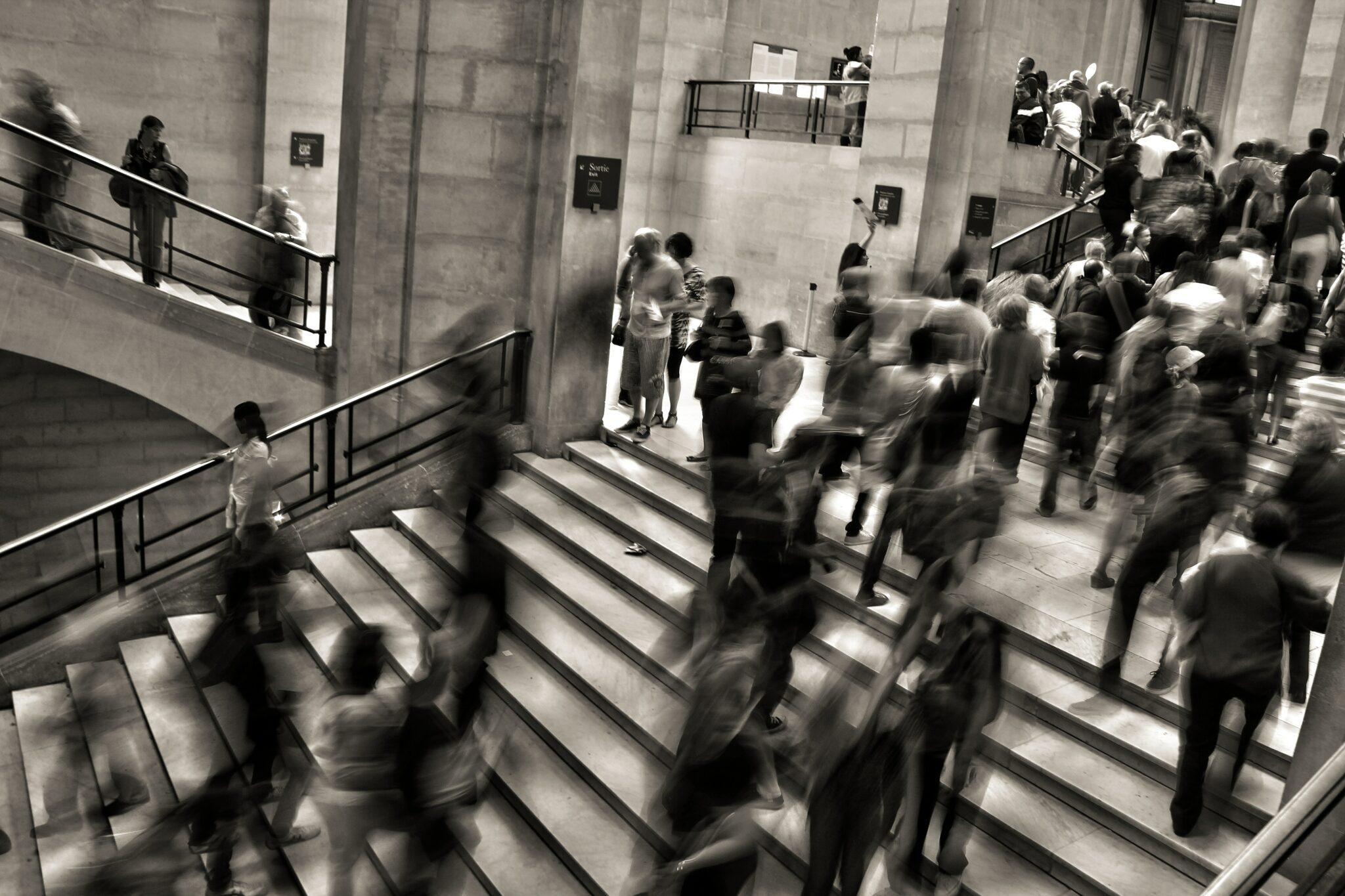
The principle of crowd management, according to Van Motman, is quite simple. The influx of pedestrians must be controlled so that space remains in the street network at peak traffic. This applies to car traffic, but also to pedestrian traffic. Crowd management is about analyzing the situation, informing and devising and deploying measures. Only when a critical situation arises is the police called in for so-called crowd control, such as closing a street.
Efforts are being made to avoid crowd control and redirect flows of people as "smartly" as possible. Van Motman points out that this is not new; even prior to the deployment of sensors, a prognosis was made of the number of visitors, and these were put into a simulation model (of Dam Square, for example). In this way, the municipality made it clear in advance where problems might arise.
A new step, also called "smart crowd management," is the use of sensors to provide faster, better and real-time response. 'Since Sail Amsterdam 2015, we started testing with Wi-Fi tracking and remote cameras. That involves a lot of thinking: where to measure and how best to measure?' Wifi tracking measures a MAC address, a unique identification number of a mobile device, while remote cameras measure the number of people and their posture. The two data sources are then used to analyze the situation on the street, with pedestrians becoming dots on a digitally simulated map.
After the successful test of Sail Amsterdam 2015, permanent measuring installations were installed in the Kalverstraat and on the Red Light District, with the aim of building long-term knowledge about both technology and traffic flow. 'The idea was: an event is only for three or five days, we now want to measure structurally and long-term. With events you often have a peak load, and on the Red Light District this is actually going on continuously.' An initial analysis showed that too many people in various alleys on the Red Light District created dangerous crowds especially in the evening hours and weekends, with people having nowhere to go.
By determining the number of people and their walking directions, this data could be incorporated into the simulation model in real time. This simulation model includes all objects and infrastructure of the environment and gives indications of the density of people. Since the density was too high, it was devised to use hosts. These are people who manage the crowds in alleys. 'We don't want to close streets right away, we are looking for "soft" measures. Hosts help to make sure there is a flow to the left and a flow to the right, and they maneuver people through.'
Van Motman emphasizes that technological and human intervention come together here; the measurements complement the activities of officials and help determine which deployment of hosts will be most useful in achieving even more effective solutions.
The data collected can also lead to measures at other levels. For example, police personnel planning can be adjusted if it turns out to be busier or quieter. Or insight can be gained into the strain on the city's infrastructure: 'When a quay and a bridge had to be replaced on the Red Light District, the municipality wanted to remove them and replace them later. Based on the data, we concluded that an emergency bridge really had to be placed, otherwise problems would arise.'
The project is creating hefty data streams from sensor measurements. All the data now end up on a platform, which is managed by a commercial private company. 'What we are working on now is to host that platform within the municipality of Amsterdam. We want to have control over the data, that way we can also share that data with municipal partners to develop useful applications.'
It should be clear that there are absolutely no commercial intentions, the measurement of crowds is not intended to entice visitors to walk past certain stores or products as happens at commercial parties such as shopping malls. 'With businesses you always have commercial aspects that come into play with walking routes and crowds. We only focus on comfort and safety.' Van Motman also wants to emphasize that researchers at the municipality never follow individual people: 'We are not interested in the individual, that is not crowd management.'
The project was tested for privacy criteria at the Amsterdam Commission for Personal Data. To clearly communicate with the public, a website has been created and signs have been placed at the places where measurements are being taken. So far, the city council and the entrepreneurs on the Red Light District are responding well to the project. An interesting side effect is that bar owners indicate that there are fewer street dealers on the Red Light District because there are permanent hosts walking around.
For the future, Van Motman sees lots of opportunities to apply data in the city. 'Infrastructure is often rigid, but a smart city is flexible. In the morning we see a bicycle peak, then we open extra bicycle lanes. Then we throw open two lanes for trucks. And in the afternoon it becomes one big footpath.'
In the long term, the entire mobility chain from Schiphol to Amsterdam could be mapped. The arrival of charter flights at Schiphol can then be anticipated in the city, for example. However, solutions like this are still a long way off. For the near future, work is underway to make public a dashboard with data on traffic density so that visitors can weigh whether or not to go to a particular area. 'If you make it clear what you are doing it for, and what it benefits the citizen, then I really believe that the citizen is willing to cooperate.'
source: Rathenau Institute