During the lockdown, moving to an online learning environment proved to be anything but. Schools switched en masse to an online learning environment faster than we had seen coming. The physical classroom thus suddenly appeared in a completely different light. This digital transformation raised the following question: To what extent is the physical class actually needed and why?
At a time of crisis, when education had two options - become digital or quit - reaching for the digital alternative was a logical step. As with any crisis, the pandemic and the measures that accompanied it made the underlying structures of our society more visible.
With the rapid transition to digital education, the inequality of opportunity in education was exposed. A degree of inequality that goes beyond access to material resources. Someone who can talk more about this is José van Dijck, professor of Media and Digital Society at Utrecht University. Van Dijck's research focuses on ''the public values in the online world such as accessibility, privacy and security, but also democratic control, for example through the effect of algorithmic control on the provision of information, pluralism in journalism or the design of education'' (2).
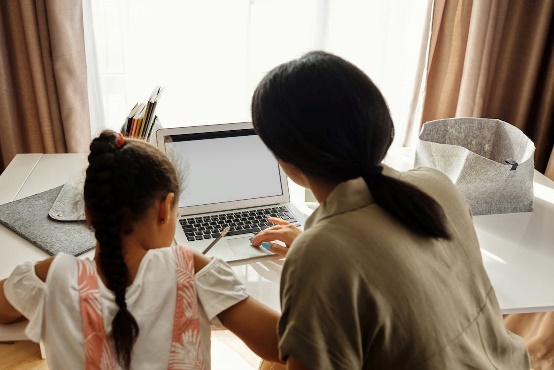
''We were already seeing opportunity inequality in education,'' Van Dijck states. ''During the pandemic it intensified, because a number of children had to work at home and they found that their home situation was very influential in how they were supported digitally. Differences that were already quite significant became more visible because of that digital divide, both because of materiality, i.e. the technology you have at home, but also precisely because of that parental support. Then it becomes very clear that we widened the gap rather than narrowed it''.
While there is much talk about the role of devices in widening the gap between rich and poor learners (3), these digital resources are primarily a reflection of inequality in literacy. The digital support required by the transition to an online learning environment does not come naturally to every learner in the Netherlands. ''If you're not literate, that is, not well versed in reading and writing, you can't properly develop your digital literacy either, because that's really the basis for what comes after that,'' van Dijck said. Technological resources without equity in literacy, then, make the gap among "sufficiently literate" and "less literate" students especially palpable. Thus, the pandemic has shown that digital educational participation is directly inferior to the level of literacy among students in the Netherlands, and therefore, redressing equity in education must start with literacy.
So digitization does not constitute a ready-made antidote to opportunity inequality in schools.''People often think that we can use technology to give students who are lagging behind a push in the right direction. But then we often forget that precisely those children don't need digital support so much as personal support from a teacher or parent. So it sometimes has a double punitive or disadvantageous effect if you send that child an adaptive learning program, like 'do that yourself'; that is exactly what that child cannot do," says Van Dijck.
Such reinforcement of the pre-existing structural educational disadvantage of certain students is reflected in the "social pain" referred to by educational sociologist Iliass el Hadioui (4). This social pain occurs when students cannot connect their school and home lives and, as a result, do not experience a sense of belonging. According to El Hadioui, who is also the founder of the Transformative School, an innovative educational program in a multicultural urban environment, the importance of physical guidance in fostering equity among students became especially noticeable during the lockdown.
What transpired is that during physical class, students are monitored in a positive way. ''When all the students are in the classrooms, a lot of 'fixing' is done there. Students who are struggling for a while are then taken along anyway, with the attitude 'if it doesn't work out today, it will work out tomorrow.' So there is a kind of interpersonal dynamic where you keep an eye on each other, whether everyone is keeping up. And that, of course, was lost during the lockdown,'' El Hadioui said.
Besides the intention for customized guidance through the use of digital resources, the ''illusion of a digital replacement effect,'' to which José van Dijck refers, also appears to be a stimulating factor in the rapid digital educational transformation. ''Digitalization is ostensibly going to replace people, but that is an illusion, that is not possible at all. You can't replace people at all, again you need people to create those systems, to maintain them. The emphasis in professionalization only shifts from education to technology,'' Van Dijck said.
So even as a possible approach to the teacher shortage, digitization of education falls away.
Both speakers believe that the basis of education should be physical. ''Because people are flesh and blood and carry with them a certain energy, which plays a very important role in a physical space,'' shared El Hadioui. However, digital tools do receive recognition in their potential to contribute to reducing mobility and saving time; as long as they are effective.''You have to think for yourself about what fits into your pedagogy, what fits into your didactics, what fits into the school system you want to convey. It is part of the professionalization of the teacher to be able to make choices in this also in consultation with the school and colleagues. In doing so, we must not only pay attention to what we do with technology, but also to what technology does to us and what (side) effects it has on the student,'' Van Dijck states.
The pandemic has provided room for reflection and a re-evaluation of physical education, as well as the effectiveness of digital learning. With today's "Covid knowledge and experience," schools have both the opportunity and autonomy to choose in what ways, if any, they want to use digitization in their educational curriculum. Devices apparently cannot fill the gap between rich and poor, but they can provide additional time and opportunities. Perhaps critical and reflective use of digital tools in the physical learning curriculum is the key to a new classroom, where more time can contribute to greater equality in literacy among students in the Netherlands. The goal: healing the wound of unequal literacy among students, rather than striving for a high-tech band-aid.
https://www.accouitgeverij.nl/content/de-digitale-versnelling-het-onderwijs-door-de-corona-crisis
https://www.uu.nl/medewerkers/jftmvandijck
https://www.imcweekendschool.nl/kansenongelijkheid-bestrijden-met-laptops
https://www.verus.nl/actueel/nieuws/socioloog-iliass-el-hadioui-kansengelijkheid-gaat-ook-over-de-mindset-van
https://www.kennisnet.nl/artikel/6627/iliass-el-hadioui-grondlegger-van-de-transformatieve-school/