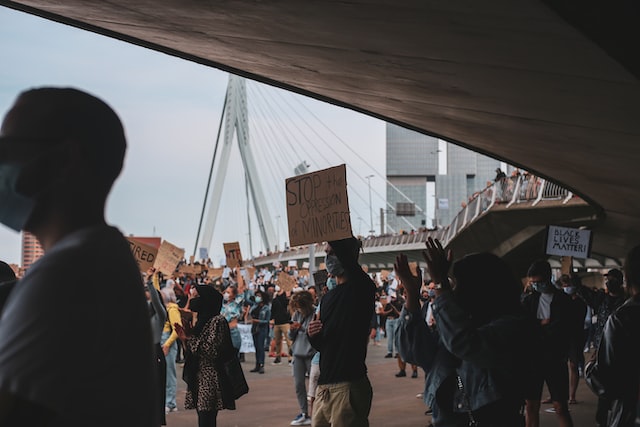
The police constantly collect personal data from protesters. This includes such things as home address, date of birth and citizen service number. Furthermore, the police regularly request data from parents and children of activists, without them ever having been convicted or arrested for anything. Privacy experts warn that the fundamental rights of citizens are affected.
That picture emerges from an investigation by the journalistic research platform Investico in cooperation with Trouw and De Groene Amsterdammer.
Since 2021, it will be possible for anyone to request from the municipality an overview of data traffic between the police and the Basic Registration of Persons (BRP). The police consult this database to request personal data of suspects, such as residential addresses, dates of birth or contact information. In its own words, this is necessary to carry out its tasks, for example to track down suspects, process reports or get in touch with activists or victims.
But how often do the police consult the BRP? And on what scale does it happen? In consultation with protesters, journalists studied 67 personal files of protesters who are members of groups such as Extinction Rebellion and Kick Out Zwarte Piet.
What turns out? For some members, police consulted the BRP database hundreds of times. The data of Michel Reijinga, a prominent coronademonstrant, were accessed more than 1,400 times in two years. The details of an organizer of Kick Out Zwarte Piet were consulted more than 300 times.
Investico further concludes that ten of the 67 protesters had never been arrested or convicted before. The personal data of seven activists were requested more than fifty times from the BRP database. Finally, it appears that the police also regularly request the data of parents or children of protesters. This happens when activists have seriously disrupted public order.
The protesters who cooperated with the investigation reacted with shock. "The government is trying to disqualify me because they don't like my message. What are my rights worth then?", Marisella de Cuba of Kick Out Zwarte Piet wonders aloud.
Privacy experts find this development worrisome. "The technology is there, it is very easy for the police to look for people more and more quickly and earlier. But especially since this is a fundamental right, the police should be cautious in doing so. If they even look up family members with everyone, it turns out they are not," said Marc Schuilenburg, professor of Digital Surveillance at Erasmus University.
Bart Schermer, professor of Privacy and Cybercrime at Leiden University, agrees with Schuilenberg. "The right to demonstrate is at stake. If you are watched all the time, you can no longer demonstrate freely."
Police said in a response that personal data is recorded "very generally" and that there is no specific policy for requesting data from protesters.
https://www.platform-investico.nl/artikel/politie-verzamelt-op-grote-schaal-persoonsgegevens-demonstranten/