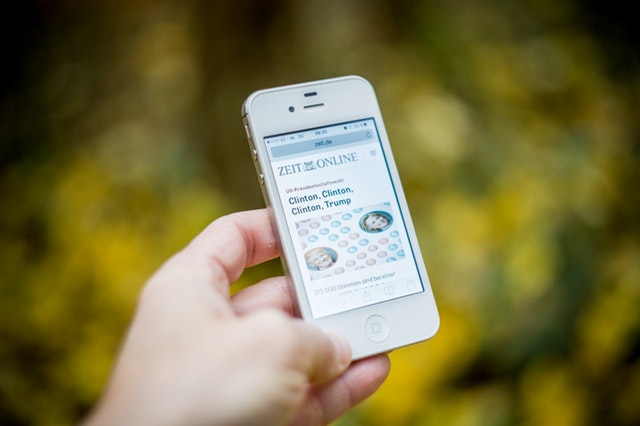
Criminal lawyer Sidney Smeets announced an unexpected career change via Twitter: ''Happy to finally announce today that I will join the Senate on behalf of Forum together with Johan Derksen. Johan will be spokesperson for emancipation and I will take care of public health and sports. Many thanks to Thierry and Theo for their trust.'' This tweet was an April 1 joke. For people who know Sidney Smeets, this will probably be immediately obvious, but for the less observant Internet user it will be less obvious. Sidney Smeets' tweet is a fairly innocuous example, but the influences fake news are anything but innocuous. One consequence of the "rise" of fake news is that we have arrived in a time of polarized truth. There is no longer a general consensus on truth and people are selective in taking in so-called facts.
Author: Ivo Janssen
Fake news is as old as the phenomenon of news itself. Disinformation, political propaganda, juicy conspiracy theories and out-of-control April 1 jokes are not absent from our history; indeed, they are of all times. So this phenomenon is not new, but the volume of fake news has grown significantly due to digitalization of our society. Facebook and Twitter benefit from as many interactive users and bots sharing as possible. As a result, fake news is an extremely suitable means to exert political influence, or to make money by advertising the erroneous news. According to a report by the French Ministry of Foreign Affairs, 80 percent of all fake news in Europe comes from Russia. Another study conducted at the request of our own Transatlantic Commission shows that up to 20 percent of all online conversations, for example on Twitter, are generated by bots. These figures do not say to what extent the messages disseminated have undermined or destabilized the democratic rule of law, but that there are noticeable effects seems obvious to me.
The government - from a fundamental law perspective - must exercise extreme restraint in regulating fake news. The restraint lies in the fact that the government has, on the one hand, the positive obligation to guarantee fundamental rights and, on the other hand, the negative obligation not to interfere with these fundamental rights of individuals. The fulfillment of the positive obligation may affect the negative obligation, and vice versa. Take, for example, a blanket ban on fake news; such a ban may protect citizens from socially disruptive effects, but it also entails that gossip or satire falls within the scope of the ban, impinging on freedom of expression.
Another fundamental objection to a government that (too) actively interferes in the fight against fake news through regulation is the question of what the distinction between real news and fake news is. Is all news that is not 100 percent verifiable fake? What sources does the government use for verification? If a government passes fake news legislation that allows for fines or actively fact-checks, the appearance of bias or censorship cannot be excluded, which also means curtailment of freedom of speech. At the same time, the latter argument should be treated with caution, as there is a danger that everything can be subsumed under freedom of expression.
The foregoing might suggest that I am against any form of government interference, but I am absolutely not. Initiatives such as the online awareness campaign 'Stay curious. Stay critical' launched by the government last March 11 I encourage at all times. As stated, a government that does nothing at all falls short of its positive obligations. So there is indeed a regulatory role for government, but in a facilitative manner.
Former MP Mei Li Vos agrees that there is a role for the government with regard to the fake news issue. In her view, the core of the fake news problem is closely linked between the few critical Internet users and the earnings model of the social media. The latter in particular is said to have a negative impact on quality journalism. Much revenue that used to come to newspapers through ads and subscriptions is now being gobbled up by social media platforms with the result that the counterbalance that comes from carefully executed journalism is being lost. The government could, for example, facilitate a fund for independent journalism with an internet levy agreed EU-wide. By doing so, on the one hand, you tug at the revenue model of the platforms, and on the other hand, you ensure that journalists can continue to do their jobs. In this story, Internet giants (think facebook, twitter and google) contribute to regional media through that fund, through an additional levy on Internet advertising. Again, there are fundamentally oriented objections to this, but if a government manages to leave full governance to independent experts, and then stays as far away from this itself as possible, it may be justifiable.
More from SOLV Lawyers