Today, noyb.eu sent more than 500 complaints to companies using illegal cookie banners - the largest load of complaints since the AVG (or GDPR) went into effect. According to the law, users must be given a clear yes/no option when asked for consent. Since most banners do not comply with the requirements of the AVG, noyb has developed software that recognizes different types of abusive cookie banners and automatically generates complaints. noyb is nevertheless giving companies a month to comply with EU law before filing the formal complaint. noyb will use this system to ensure that in a year, up to 10,000 of Europe's most visited websites comply with the requirements. If the approach works, users will see simple and clear "yes or no" options on more and more websites in the coming months.

The AVG was intended to ensure that users have complete control over their data, but being online has become a frustrating experience for people across Europe. Irritating cookie banners appear on every corner of the Web, often making it extremely complicated to click anything other than the "accept" button. Companies use so-called "dark patterns" to get more than 90% of users to "agree," while statistics show that only 3% of users actually want to agree.
Max Schrems, president of noyb: "An entire industry of consultants and designers is developing insane click labyrinths to obtain imaginary consent rates. Frustrating people to click "okay" is a clear violation of AVG principles. By law, companies must allow users to express their choice and design systems fairly. Companies openly admit that only 3% of all users actually want to accept cookies, but more than 90% can be persuaded to click the 'agree' button."
Many Internet users see this annoying situation as a direct result of the AVG, but in fact companies are designing their websites in violation of the law. The AVG requires a simple "yes or no" question, as reasonable people would expect, but companies often have power over the design and wording when implementing the AVG.
Max Schrems: "Some companies are clearly trying to do everything they can to make privacy a hassle for users, when they have a duty to facilitate choice. Almost all situations where users have to deal with data protection are designed by companies. They often deliberately make a nightmare out of privacy settings while blaming the AVG for it. This story is repeated on hundreds of pages so that users start thinking that these ridiculous banners are required by law."
To address this extremely widespread problem, noyb has developed a system that automatically detects different types of violations. The noyb legal team reviews each Web site while the system automatically generates an AVG complaint. Companies are emailed an informal draft complaint and even given a step-by-step guide on how to change their software settings to comply with the law. However, if companies choose not to change their settings within a month, noyb will file a complaint with the relevant authority, which can impose a fine of up to €20 million. More details can be found in the platform's FAQ.
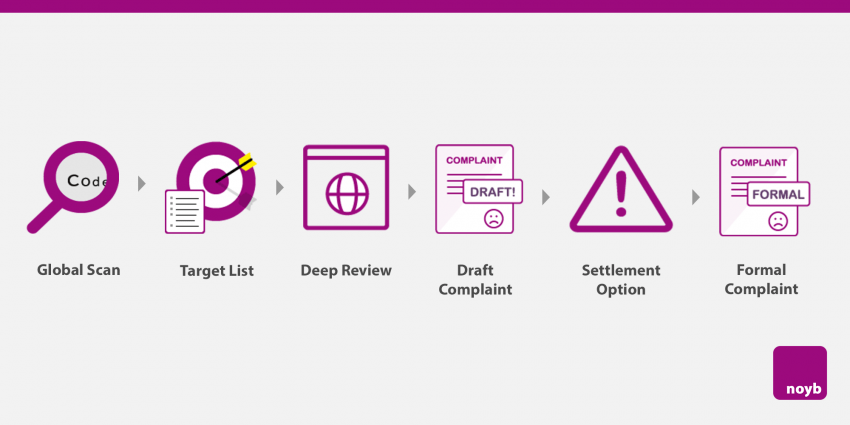
Max Schrems: "We want to make sure the rules are followed, ideally without bringing cases. However, if a company continues to violate the law, we stand ready to enforce users' rights."
Of the more than 500 websites complained about, 81% did not even offer a "decline" option on the home page at all. Users had to dive into submenus to find a hidden "decline" option. Another 73% used misleading colors and contrasts to get users to click on the "accept" option. Overall, 90% offered no way to easily withdraw consent.
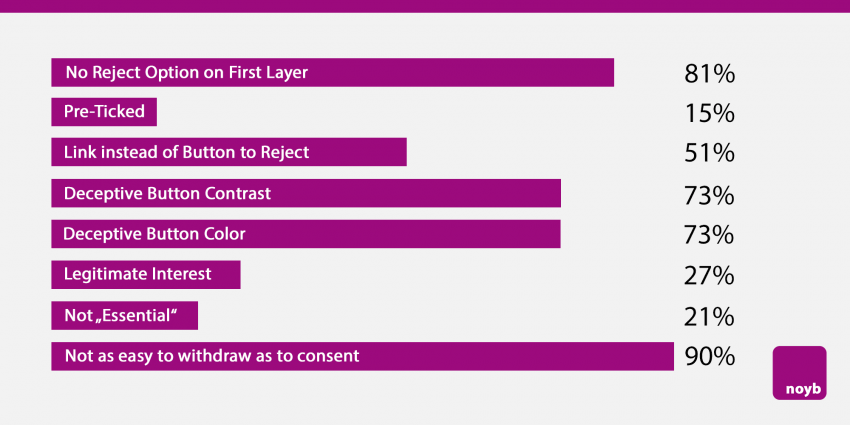
Max Schrems: "Instead of providing a simple yes or no option, companies are using every trick possible to manipulate users. We have identified more than 15 common forms of abuse. The most common problem is simply not having a 'decline' button on the home page."
noyb launched the new system today and has delivered the first drafts of complaints to 560 websites from 33 countries, including every EU/EEA member country except Malta and Liechtenstein. They range from major players such as Google and Twitter to local websites with significant visitor numbers. Noyb's plan is to have up to 10,000 such complaints tracked over the course of 2021. The scheme is free of charge to the companies, as noyb is funding this project through donations from its approximately 4,000 supporting members.
Max Schrems: "We are targeting popular Web sites in Europe. We estimate that this project could easily cover 10,000 complaints. Because we are funded by donations, we offer companies a free and easy settlement option - unlike law firms. We hope that most of the complaints will be settled quickly and that soon we can see increasingly reasonable banners."